

The photo above is the Dolly Parton mural in West Asheville, North Carolina. There’s a story about it that I’ll tell in a minute. For now I wanted to mention that it’s the mural in West Asheville so I could distinguish it from the Dolly Parton mural in Indianapolis; or the Dolly Parton mural in Chicago; or the one in Ringgold, Georgia; the one in Costa Mesa, California; the one in Lexington, Kentucky; the one in Appomattox, Virginia; the ones all over Tennessee—Nashville, Knoxville, Pigeon Forge—or the one here in Charlotte, not two miles from our house. I’m sure there are more but I stopped scrolling the Dolly Parton mural image search so I could get down some words.
One way to measure who we love in this country is to see who we paint on the sides of buildings. I doubt there are many people painted on the sides of more buildings in this great land than Dolly Parton, who somehow died Tuesday at the age of 80, although death is an odd notion when it comes to Dolly, because obviously what she did and who she was will live forever.
I’ve told friends (and maybe mentioned on social media somewhere) that if there were a bubble that could protect anyone inside from war and death and disease—like the bulletproof limo that protects the president—the three Americans I’d put in there would be Dolly, Stevie Wonder, and Bruce Springsteen.
My friend Joe Posnanski called today when he heard about Dolly.
“What about Willie?” he said.
“He gets her spot,” I said.
“He wasn’t in there already?”
“Not sure there was enough room.”
Joe and his partner in podcasts and writing, Michael Schur, have a running bit where they refer to Dodgers shortstop Mookie Betts as the greatest living American. Mookie Betts is in fact a great American. But there was no chance he was the greatest living American, not when Dolly was around.
She was a no-doubter on the list of greatest songwriters in popular music history. She was a brilliant singer and could play guitar, banjo, piano, fiddle and sax, all in 3-inch acrylic nails. She was a gifted comic actress and a Hall of Fame interview. She used her riches to become one of the great philanthropists of our lifetimes. She gave money to rural high-school grads and people whose homes were destroyed in the wildfires in East Tennessee. She helped finance one of the early COVID vaccines. And she has given away more than 270 million books to kids all over the world through her Imagination Library. One in seven children under the age of 5 in the United States gets a book every month from Dolly.
Here is her greatest gift: If you gave every category of people a circle in a massive Venn diagram—straight and gay, liberal and conservative, white and black, Asian and Hispanic, trans and cis, devout and atheist, old and young, billionaire and broke—Dolly is the place they all overlap. That doesn’t mean everyone loves her. It means more different types of people love her than they love anybody else.
Do you understand how hard that is? To make everyone feel welcome at the table and not come off as phony, or bland, or grasping for cash? Dolly is the universal icebreaker. You can wander into the grimiest biker bar, or the poshest country club, and know that someone in there loves “Jolene.”
I guess this is the time I should come back to that mural in West Asheville. The artist painted it in 2018. Three years later, he added a second figure:
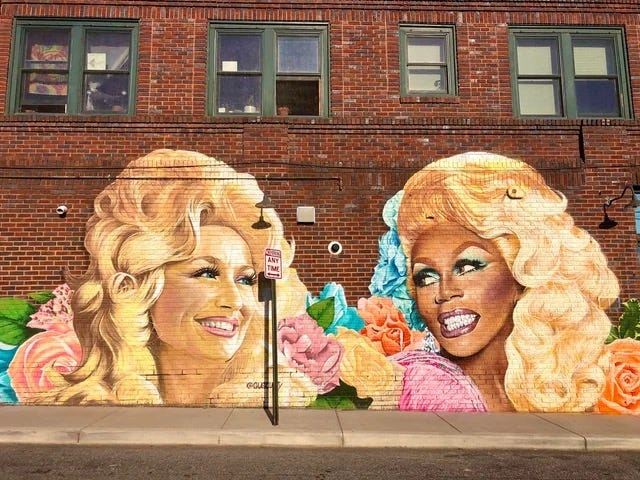
Dolly and RuPaul. Bewigged icons. Kindred spirits.
But you could’ve put almost anyone there and it would’ve worked. Dolly belongs to everybody.
***
I’m sure a lot of you have spent these past few hours listening to your favorite Dolly songs or watching your favorite clips. I thought of the one from a vacation she took to Ireland back in 1990. The story goes that she decided to duck into an Irish pub just to see what one was like. She chatted with the regulars. She was not planning to perform. But the guitar player in the pub knew “Coat of Many Colors.” So she took the mic.
My favorite Dolly song changes all the time—if I had to pick at gunpoint, I’d probably take “My Tennessee Mountain Home”—but “Coat of Many Colors” comes closest to explaining how Dolly became Dolly. It’s the true story of the coat Dolly’s mother made for her out of scraps and rags, and how her schoolmates laughed at her, not understanding how much beauty could come from craft applied to love.
Dolly understood.
There is another story I think of now, the one about “I Will Always Love You.” You might know it’s the farewell song she wrote to Porter Wagoner when she left their professional (and some say personal) partnership to go solo. It was a no. 1 country hit when she released it in 1974. Elvis loved it and offered to record a version himself. There was one condition: Elvis’ manager, Col. Tom Parker, demanded half the publishing rights. Dolly stood to make a lot of money with even half. But for a songwriter, publishing rights are everything. And after all, she wrote the song. Dolly said no and cried all night.
In 1992, Whitney Houston covered “I Will Always Love You” and the single alone sold more than 40 million copies.
And Dolly said: “Now I can buy Graceland.”
Her story was literally rags to riches. She was covered in fakery from head to toe but every word that came out of her mouth was real. She was a bodacious flirt who was married to the same man for 58 years. She was funny as hell even as she sang of heartbreak and betrayal. She gave back so much, in the way that the truly wealthy should and almost never do.
Dolly Parton really might have been the greatest living American. She looked and sounded only like herself, and yet so many of us can see and hear ourselves in her—well, maybe not our current selves, but the version we hope to be.
Those rhinestones were mirrors.

My books DOGLAND and THE ELEPHANT IN THE ROOM are available in all formats pretty much everywhere books are sold.
"Those rhinestones were mirrors."
Holy shit, what a line. What a kicker.
Brilliant, Tommy.
Gus Cutty is the Asheville artist, and there are dozens of bouquets in front of it already. 💛