
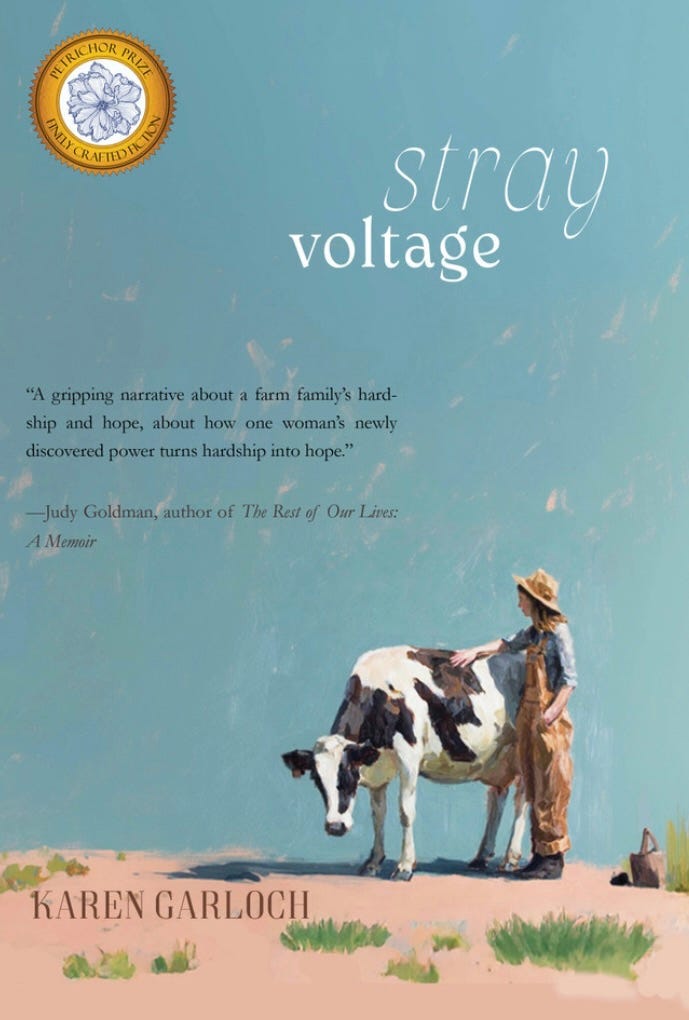
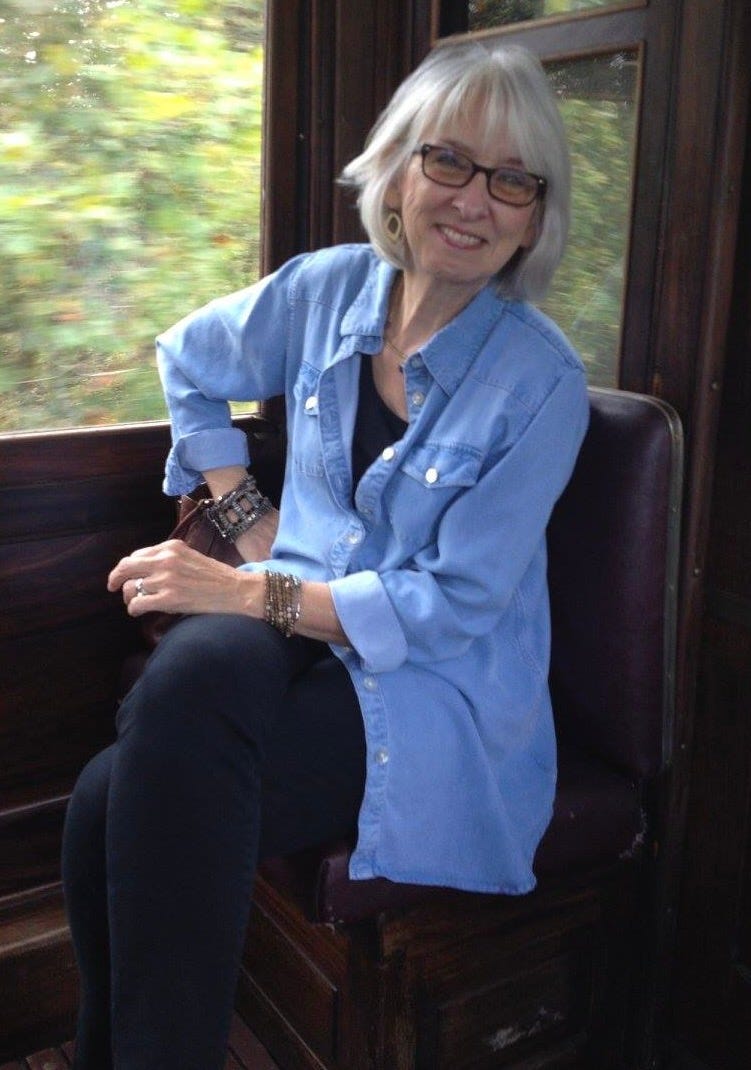
Welcome back to our Pub Day series, where I feature new books from friends and colleagues on their publication day. Today I’m honored to share a conversation with Karen Garloch about her novel (and first book!) STRAY VOLTAGE.
Karen and I worked together for more than 20 years at the Charlotte Observer. For much of that time she was the Observer’s medical reporter—one of the very best in America. She did a stressful job with skill and toughness and grace. She’s also funny as hell.
After she retired, Karen set out to write a novel. A lot of journalists think about doing that but not many of us actually do it. She did it, and did it really well. STRAY VOLTAGE is the story of Hillie Schumacher, a farm wife whose family struggles with the mysterious deaths of their cows. It’s also about the cultural hurdles Hallie has to overcome to find the answers. The book is tough-minded and smart but ultimately kind-hearted. Much like Karen herself.
She graciously answered a few questions about her book.
1. This novel is deeply rooted in a small-town Indiana farming community. How similar is the setting in the book to the life you grew up in?
It’s basically the same. The story, the name of the town, and the characters in Stray Voltage are fictional, but many of the scenes and traditions come directly from the German Lutheran community in southern Indiana where I grew up. Take the county fair. When I was young, my 4-H friends and I looked forward to that week every summer, and even though I didn’t exhibit animals, I spent lots of time hanging out in the cattle barns. Like Janie in the book, I was a fair queen candidate myself in 1969. (I didn’t make it to runner-up, much less queen.) The one-room parochial school in the book is like the one where I spent my first seven elementary grades. And the butchering scenes are based on my experience. My parents and relatives helped each other butcher cows and pigs every winter, so we’d have plenty of steaks, hamburger, and sausage to eat for the rest of the year.
2. Hillie, your protagonist, runs into a lot of roadblocks as a woman—she’s not listened to or dismissed, and she’s not allowed into spaces where men make the decisions. Is that something you felt growing up? And did it change as time went on, or once you started living in other places?
As a child, I did not notice anything unusual about the treatment of women in my farm community. It was the way things were. Women sometimes helped in the fields and with the animals, but they were primarily homemakers. In our Missouri Synod Lutheran Church, only a man could be the minister, which is still the case today. For seven years, my elementary school teacher was also a man. I didn’t think anything about it. That was our normal. As a high school and college student, I was unfortunately pretty oblivious to discrimination against women. Like many of my girlfriends, I got married as soon as I graduated from college. As I started working for Ohio newspapers in the 1970s, I became more aware of the women’s movement and how fortunate I was that, by then, women had access to birth control, could qualify for credit cards in their own names, and were able to compete for jobs traditionally held by men. A few years after I joined the Cincinnati Enquirer in 1977, I persuaded the city editor to give me the City Hall beat, a highly sought after assignment that was traditionally held by men.
As an adult, I visited my parents in Indiana frequently and realized that many things had not changed much for women. My mom accepted this as normal. But I began to wonder how I would have reacted if I had married a farmer and stayed in that community. In my novel, Hillie’s challenges are based on a combination of reality and my imagination.
3. The reader learns a LOT about cows in this book, from what they eat to how they’re milked to the diseases that might kill them. How did you gather the information you needed to write those parts of the story?
Some of it, I just knew from having grown up on my parents’ small dairy farm. To refresh my memory, I interviewed Mom and Dad and their neighbor, Dave, whose large dairy herd suffered from stray voltage damage in the 1990s and 2000s. I also read newspaper articles and farming magazines and news sites on the internet. I was surprised by how much I found about stray voltage damage to dairy herds in the upper Midwest and about farmers who filed legal claims and won multi-million-dollar jury verdicts against electric companies. I interviewed a Wisconsin news reporter who became an expert on stray voltage and a Minnesota farmer whose lawsuit resulted in a $6.3 million jury verdict in the farmer’s favor.
4. What drew you to storytelling as a career?
I’ve been keeping diaries and journals since I was in the 6th grade. And I was always good in English classes (and hated math). But my initial interest in writing stories was sparked in high school when I attended a summer journalism workshop at Ball State University. I met some really smart kids from all over Indiana, and we worked with professors who taught us the basics of interviewing and writing news stories. I majored in journalism at Ball State and began my reporting career at the Middletown Journal and the Cincinnati Enquirer in Ohio. I didn’t think of my writing so much as “storytelling” until after I moved to the Charlotte Observer in 1987. There, I was able to occasionally write narrative nonfiction in a serial form, like chapters of a book. The techniques I used for those stories were valuable when I tried fiction years later. Narrative nonfiction allowed me to take time to get to know people well enough to write about them in a deeper way than I usually could. For example, I spent several months getting to know a young couple who had made the wrenching decision to bring to term a baby with anencephaly even though they knew she would die shortly after birth. A photographer and I were invited to be with them for the 99 minutes of post-birth wonder and the eventual passing of their beloved child. That was definitely storytelling in a way that most newspaper stories are not. People need stories, and I have loved being able to share so many as a journalist and to have written this novel sparked by memories from my childhood.
5. You spent most of your working life writing nonfiction as a journalist. What was the biggest challenge in moving to fiction? What was the biggest joy?
The biggest challenge was freeing myself from the restrictions of journalism. I could no longer rely on my reporter’s notebook for details. I couldn’t rely on quotations from sources. I had to learn to write authentic-sounding dialogue and to make my characters do and say what was necessary in a particular moment. As a newspaper reporter, I rarely wrote about what people were thinking, only what they said. One of the hardest things about writing fiction was to bring interiority to my characters—to give them thoughts, feelings, and an inner life that provided purpose and motivation. That may also have been the biggest joy. I learned to imagine what my characters were thinking and figure out how to arrange events and create tension so readers would continue turning the pages. While writing this novel, I got great advice from faculty and fellow students in the Authors Lab of Charlotte Center for Literary Arts and from my editor at Regal House Publishing. My book is better because of their suggestions. I agree with Toni Morrison; revision is my favorite part of writing.
Bonus question: You’ve had lots of nights when you went to bed knowing a big story of yours was about to come out in the paper the next day. How does that compare to knowing that your first book is about to come out?
There is no comparison. Newspapers are ephemeral. They’re here today and then recycled or used to line the bird cage. My newspaper articles remain in the archives, but as a reporter, I was always on to the next story. Writing a novel, and watching it come into the world, is something else completely. It takes longer, of course, to write a novel, but it will also be around in a more lasting way. Stray Voltage will be on library and bookstore shelves. It will be on my bookshelf at home. It will be in the homes of my friends and my relatives, who I hope will pass it to the next generation. It’s a tribute to my parents and my relatives who did not live to see it. It’s not a memoir, but it will be my legacy.
***
You can buy Karen’s book pretty much anywhere books are sold … a few links:
Bookshop (you can choose which independent bookstore you want to use)
Karen is also doing a book tour in North Carolina and the Midwest; check here for dates. If you’re in the Charlotte area, I’ll be interviewing her at Park Road Books on Oct. 28. Come check it out!
—TT
If you have a book lover in your life, I bet they’d enjoy these Pub Day posts … share this one with them and help build the Writing Shed community.
And if you’re so inclined, subscribe:
Speaking of reccs, Tommy, check out Corey Pemberton's exuberant new exhibition at the Mint Museum: https://www.mintmuseum.org/exhibition/corey-pemberton-living-well/
We went this past weekend, and it filled me with joy. Very, very well curated.