
When Annie Dillard died on Tuesday, all her obituaries led with her most famous book—the Pulitzer-winning PILGRIM AT TINKER CREEK.
But for some of us, that’s not her signature book. The one we gravitate to is THE WRITING LIFE.
I haven’t read the whole thing in quite a while. But there are two quotes from that book that float across my social media feeds all the time. They were everywhere I looked the last few days. They’re two quotes I try to live by. And they apply to a lot more than writing.
Here’s the first:
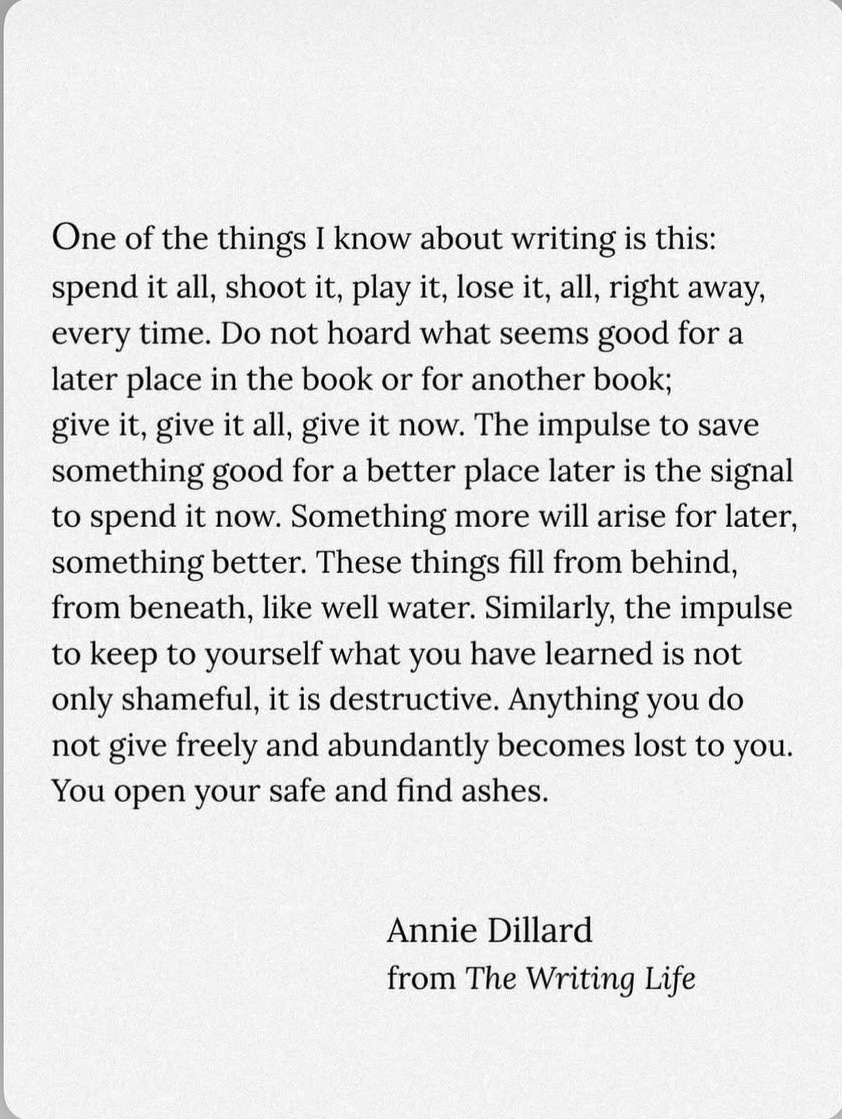
This changed my life when I first read it. I was a newspaper columnist then, cranking out four pieces a week plus the occasional feature. Sometimes I’d come up with an idea that I wanted to save for when I had more time, or I’d want to hold off until the Sunday paper, when we had more readers. I learned pretty quick that if I could fit it into my column space, I should go ahead and do it. I always did my best work when the idea still burned hot.
You can treat so many other areas of your life the same way. If you think of somebody you haven’t talked to in a while, pick up the phone. If there’s a project you’ve been longing o start, start it. Your life will reshape itself to give you time and energy. The muses will notice and deliver you rewards.
The other Annie Dillard quote I try to live by is short and simple:
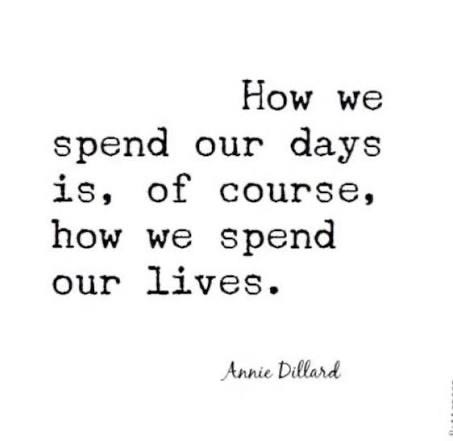
Short and simple and brutal for many of us.
What do you do in a day? Not what do you WANT to do, or INTEND to do, but what do you actually DO? If I’m honest with myself, I almost always sleep later than I should, and take too long starting on my work, and get distracted far too easily by everything from Instagram recipes to “urgent” emails to our cat prowling the house. I think it’s OK to waste time now and then. It’s important to get bored, because that’s when your brain conjures up stuff to entertain itself. But I spend a lot of time doing what my mom used to call “assling around”—procrastinating, dragging my feet, failing to launch. How we spend our days is how we spend our lives.
When I’m kinder to myself, I reframe that line. I do get to spend my days writing—the work I love the most. I get to spend part of my working life reading and listening to music and watching the sun filter through the trees, things that are valuable no matter who you are. I get to learn from so many others and share the little bit that I know. I get to send these newsletters out, knowing that they’ll land in your inboxes, and some of you will find some of them meaningful. That’s how I spend my days, and my life.
Sometimes our lives are such a whirlwind that it can pay to step back and think about how we spend them, and how we might spend them differently. Part of what Annie Dillard’s words say to me is that it’s too overwhelming a task to change your life. Just change your days. And then your life will change, too.

If this edition of the Writing Shed is meaningful to you, consider sharing it with others. That’s how you can help our community grow.
10 things I wanted to share this week:
My earlier post this week was about how a Barry Manilow song triggered the memory of the first two records I ever bought. (LOTS of great and cheesy ‘70s music in this one.)
Our friends the Posnanskis had to say goodbye to a good dog the other day. Westley was a prince. (JoeBlogs)
The McClatchy newspaper chain recently laid off dozens of good journalists all over the country, including here in Charlotte. One of those who got let go in Miami was Michelle Kaufman, a longtime sportswriter at the Miami Herald. She’s married to Dave Barry. He wrote a lovely tribute that also tells the truth about what it’s like for women in sports journalism. (Dave Barry’s Substack)
Speaking of women in sports journalism … here’s Candace Buckner of the Athletic on the whole mess involving Texas quarterback Arch Manning and ESPN broadcaster Holly Rowe.
And here’s ESPN’s Chris Fowler forcefully backing his colleague. Guys: This is how you do it. (Instagram)
One of my favorite stories every year: the new words added to the Merriam-Webster Dictionary. I had never heard of “cuffing season” before. (NYT)
Loved this lede on the oldest hiker to complete the Appalachian Trail: “More than 14 million older adults fall every year in the U.S., perhaps none so often as 91-year-old Dale Sanders.” (Associated Press)
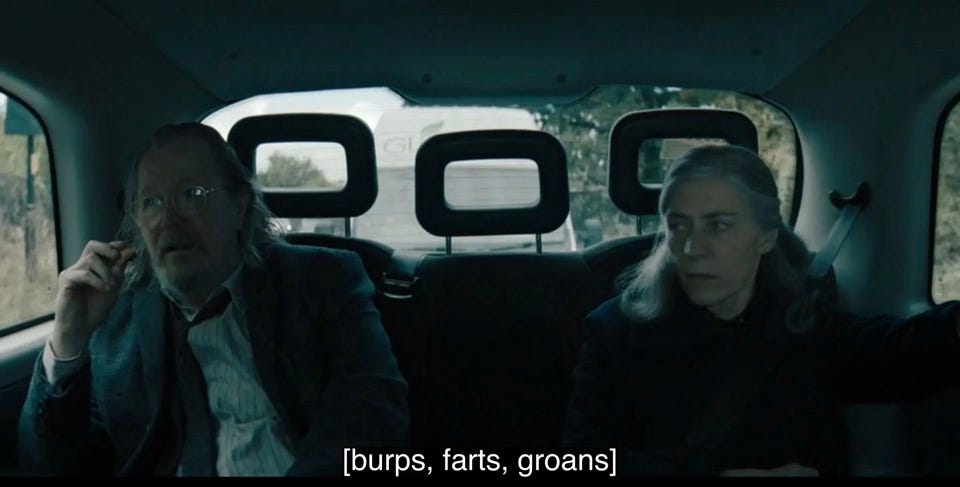
SLOW HORSES is back and I took a screenshot that probably sums it up as well as anything could:
My friend Spencer Hall posted a clip the other day of a live version of Portishead’s “Glory Box” that I had somehow never heard before. The sound quality on this is just ridiculous. And now I’m officially back in a trip-hop phase.
RIP Duncan Sheik … I had no idea about his career as a Broadway writer and composer. All I knew was his hit single “Barely Breathing,” which came out 30 years ago and has been stuck in my mind ever since. Such a beautiful piece of music.


Upcoming events
Oct. 21-22: I’m speaking at Converge-Con, a conference on artificial intelligence and creativity in Chapel Hill. Open to the public.
Have a great weekend, everybody.
—TT
My books DOGLAND and THE ELEPHANT IN THE ROOM are available in all formats pretty much everywhere books are sold.
So much goodness in this newsletter, but “assling around” will stay with me forever.
Isn't "ass-ling" around just the best part of the day tho! My mom called it piddling around. It carries a special deliciousness when doing it and knowing you should be doing something else. It's often for me that time before you have to really leave the house to get somewhere, and instead you water the plant, or literally stop and smell the roses, or suddenly need to clean the window in your kitchen. I love it. I am never late to where I need to be, but often just barely right on time because of it.